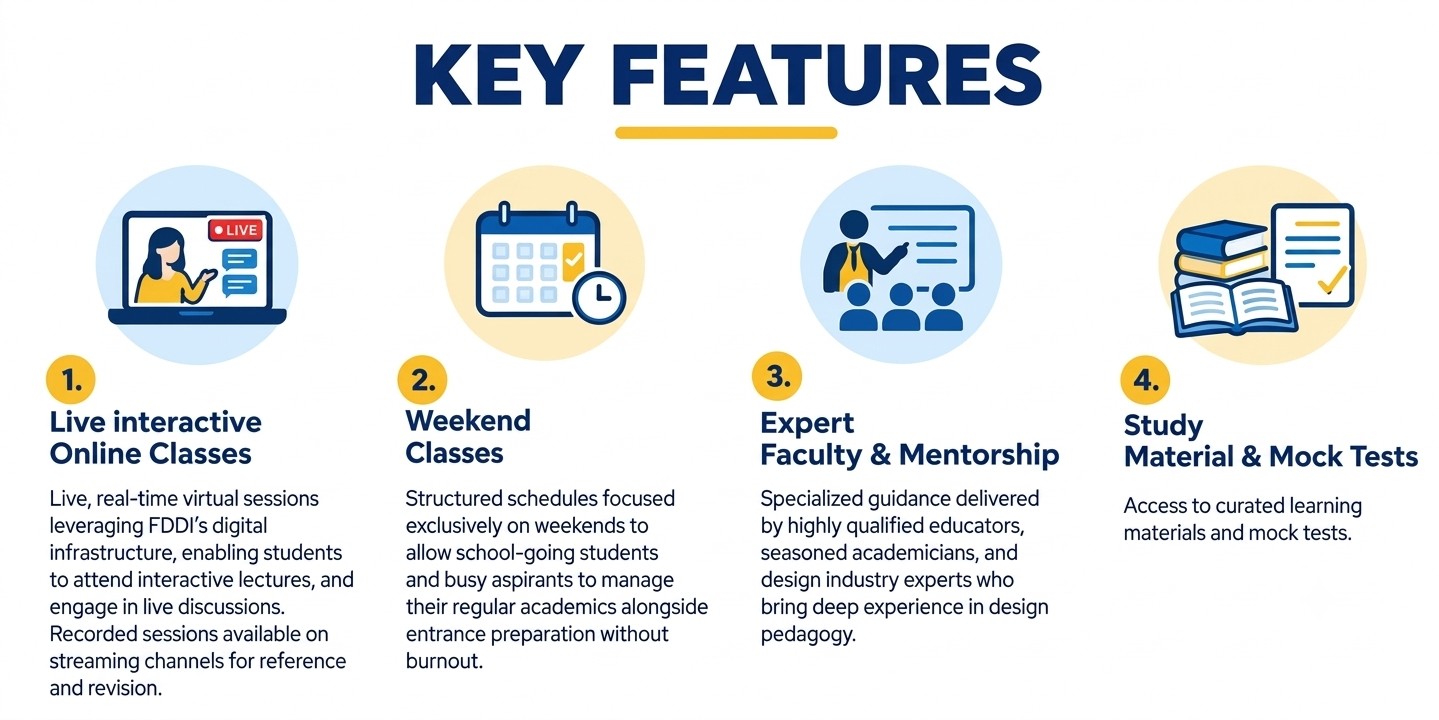

The Hon’ble Prime Minister, in his historic Address to the Nation from the Red Fort on 15th August 2026, announced a landmark initiative to provide free online coaching for various competitive examinations, reaffirming the Government’s commitment to equitable access to quality education. The initiative aims to ease the financial burden of private coaching on low-income households and empower young aspirants across India with high-quality, expert-led test preparation through the country’s robust digital infrastructure.
As a pioneer in Footwear, Fashion, Leather Goods, and Accessories Design education, the Footwear Design & Development Institute (FDDI)—an Institution of National Importance under the Ministry of Commerce & Industry, Government of India—proudly contributes to this national mission. By launching the FREE DESIGN ENTRANCE COACHING, FDDI extends dedicated support to young aspirants seeking to build vibrant careers in design-related fields, ensuring talent and passion drive success regardless of socio-economic background.
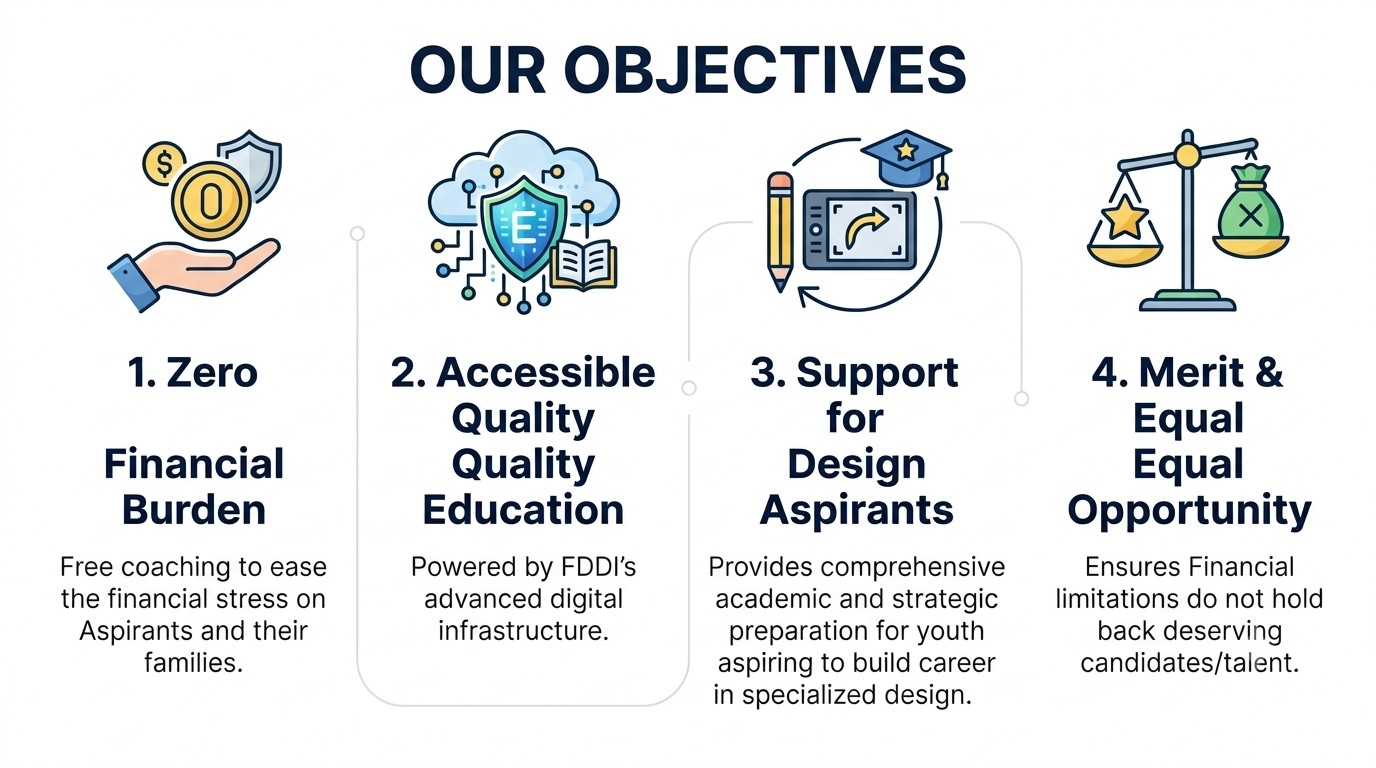
| Zero Financial Burden |
Accessible Quality Education |
Support for Design Aspirants |
Merit & Equal Opportunity |
| Free coaching to ease the financial stress on low-income households. |
Powered by India’s digital infrastructure. |
Provides comprehensive academic and strategic preparation for youth aspiring to build career in specialized design. |
Ensures Financial limitations do not hold back deserving candidates/talent. |
|
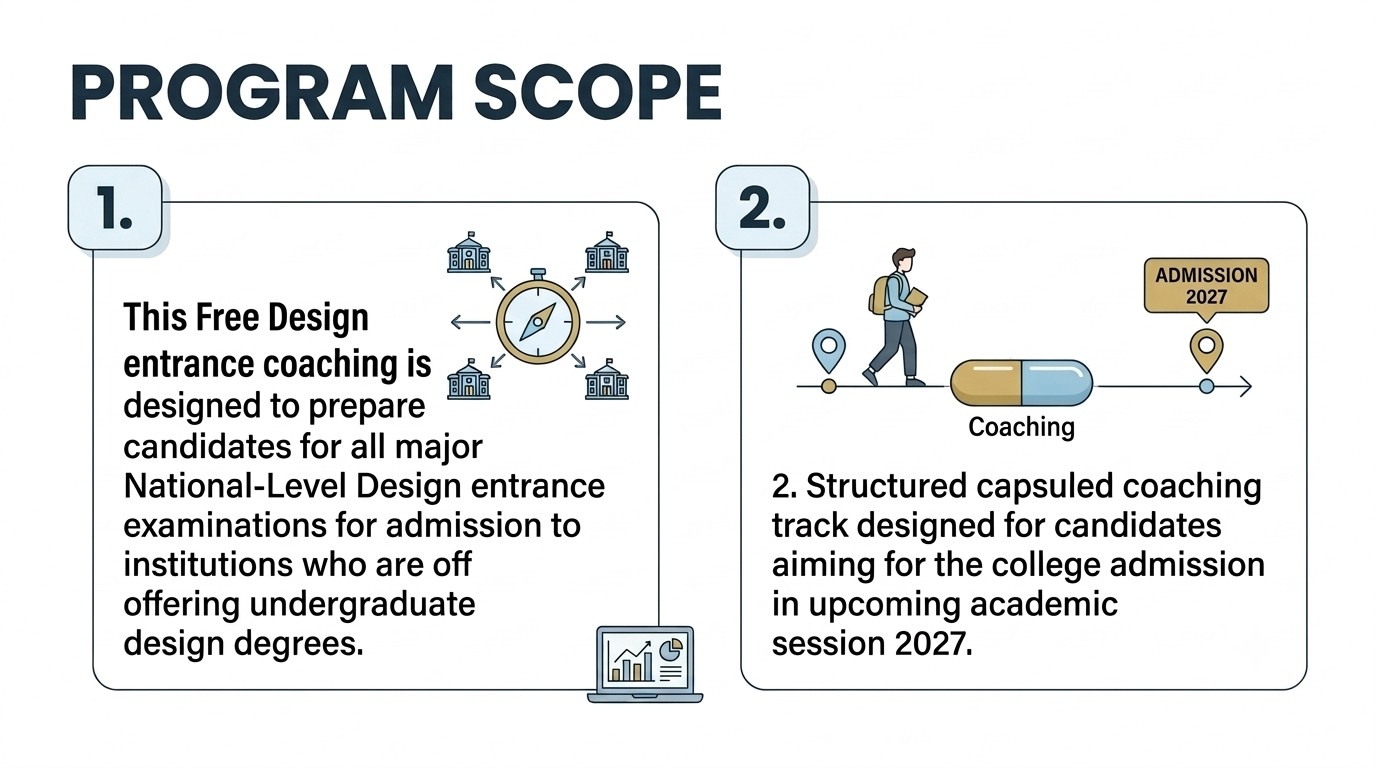
PROGRAM SCOPE |
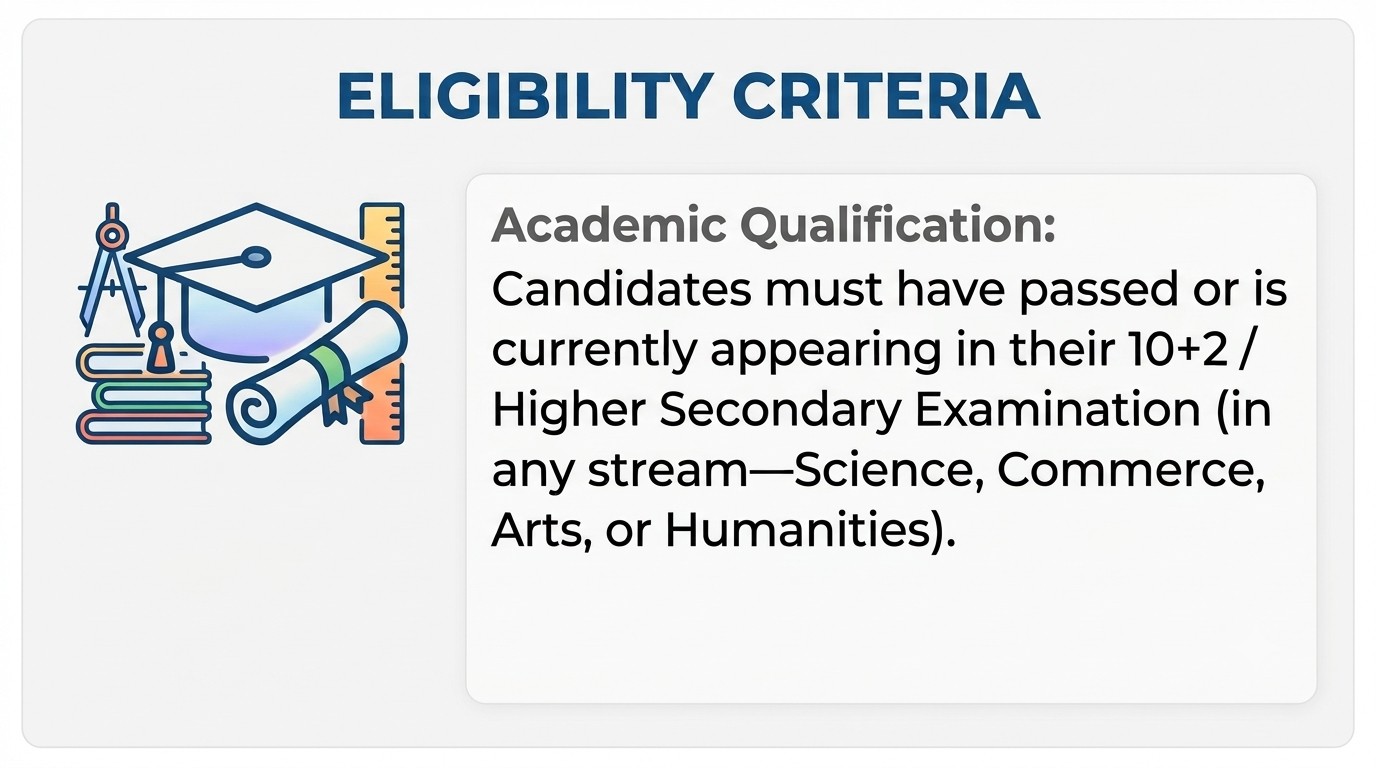
ELIGIBILITY CRITERIA |
|
1. This Free Design entrance coaching is designed to prepare candidates for all major National-Level (Govt.) and Private Design entrance examinations who are offering undergraduate design degrees.
|
Academic Qualification: Candidates must have passed or be currently appearing in their 10+2 / Higher Secondary Examination (in any stream—Science, Commerce, Arts, or Humanities) from a recognized Central or State Board of Education |
• 3D Prototyping & Footwear Tech Packs FDDI enables hands-on exposure to 3D digital prototyping, rendering, and virtual fit tools. Participants learn to prepare comprehensive tech packs (specifications, bill of materials, stitching details) critical for sampling and production.
• Orthopedic & Sustainable Footwear Labs Specialized training in ergonomic footwear for medical, senior, and orthotic markets. Sustainability-focused labs also introduce low-carbon and recycled materials with design thinking integration.
What FDDI Offers:
• Defect Detection & Prevention Training Programs on quality checkpoints from raw materials to finished goods. Training includes live defect analysis, grading systems, and rejection minimization techniques.
• Footwear QA/QC Audit Training (BIS & SATRA Models) FDDI trains factory professionals on internal audits using global models like SATRA and Indian standards (BIS), enhancing consistency, safety, and export quality assurance.
• Testing Lab Access & Demonstrations Stakeholders get guided access to FDDI’s advanced labs, equipped for testing adhesion, flexing, slip resistance, abrasion, etc. Demonstration sessions familiarize MSMEs with compliance metrics.
• Compliance Training (REACH, CPCB, ISO) Exporters and manufacturers are trained on EU (REACH), Indian environmental norms (CPCB), and ISO standards for chemicals, adhesives, labeling, and sustainability audits.
What FDDI Offers:
• On-Site Mobile Training Centers FDDI offers to establish temporary Mobile Training Centers directly at the premises of interested industry partners. These setups are equipped with the necessary machinery and infrastructure aligned with the approved training modules, enabling seamless execution of skill development programs on-site.
These mobile units allow industry clusters, MSMEs, or remote units to train their workforce without relocation or productivity loss. The training modules are customized based on the segment of workers—including operators, supervisors, technicians, and quality staff—ensuring scalable and context-specific skilling solutions.
• Chemical & Adhesive Handling Training Specialized modules on material storage, PPE, ventilation systems, and fire safety ensure safe operations, particularly around PU, rubber, and solvent-based adhesives.
• Workplace Ergonomics Training FDDI addresses occupational health by training line managers and operators on workstation design, tool usage, and postural best practices reducing repetitive strain injuries.
• Material Innovation Boot camps FDDI hosts sessions introducing sustainable materials like mushroom leather, recycled EVA, and cork. Designers and factory owners are trained on how to integrate these into product lines.
What FDDI Offers:
• Start-up Incubation & Retail Launch Guidance FDDI mentors early-stage entrepreneurs in designing collections, pricing, branding, and packaging. It supports business modeling and connects them to domestic and export buyers.
• Small-Scale Footwear Manufacturing Support Training for micro-units in segments like school shoes, sandals, and basic sports footwear. It includes sourcing plans, layout design, cost-effective equipment use, and workforce planning.
• E-Commerce Enablement & Digital Retailing Programs on D2C selling, digital marketing, product photography, and online platform onboarding (Amazon, Flipkart, etc.) equip artisans and small brands for modern commerce.
• Cluster Branding & Export Readiness Toolkit FDDI supports MSME clusters in developing shared brand identities, collective packaging, and basic compliance readiness for exporting footwear under a regional label.
What FDDI Offers:
• Green Label The Green Label certification focuses on environmental compliance and sustainability. It covers critical aspects such as the use of restricted substances, adoption of eco-friendly manufacturing processes, and incorporation of sustainable materials. This label holds significant market value by enhancing product acceptance in environmentally conscious global markets such as the EU, USA, and Japan.
• FDDI Mark of Excellence The FDDI Mark of Excellence emphasizes superior product quality, performance, and innovation—excluding environmental factors. It covers attributes like durability, comfort, fit, safety, and aesthetic craftsmanship. This mark adds market value by distinguishing premium products in competitive retail and export sectors. It also serves as a mark of recognition for quality that exceeds basic statutory requirements like QCO and BIS. Currently, we are conducting a market analysis to evaluate industry demand, recognition needs, and the practical impact of implementing these certifications.